
Lower Elevation “Water Towers” Offer Less Secure Summer Supplies, Kootenay Monitoring Data Trends Suggest
Living Lakes Canada data highlights key differences in water availability across elevation gradients in the East and West Kootenays
In an increasingly unpredictable and extreme climate, living among loftier peaks provides a key advantage: a potentially more secure water supply. Monitoring data collected across the Columbia Basin this year reveals significant differences in water availability between streams draining from low- and high-elevation snowpack.
Mountains act as natural “water towers,” capturing and storing winter precipitation as snow, ice, and glaciers. During warmer months, this snowpack gradually melts to sustain creeks, streams, and rivers. However, the exceptionally warm 2025–26 winter delivered rain instead of snow to many mid- and low-elevation areas. In the Columbia Basin, that was especially prominent in the West Kootenay, where mountains are generally lower elevation than in the East Kootenay region.
Higher elevations in the East Kootenay region retained more snowpack, according to the River Forecast Centre, of the Ministry of Water, Land and Resource Stewardship. Trends from Living Lakes Canada’s monitoring data show that streams fed by these mid- to high-elevation watersheds maintained steady flows into spring and early summer. In contrast, the West Kootenay region had historically-low snowpack in some areas, which was also reflected in Living Lakes’ water data trends. (Find more details about the impact of elevation on water supplies that depend on snowmelt in our Watershed Bulletin #6.)
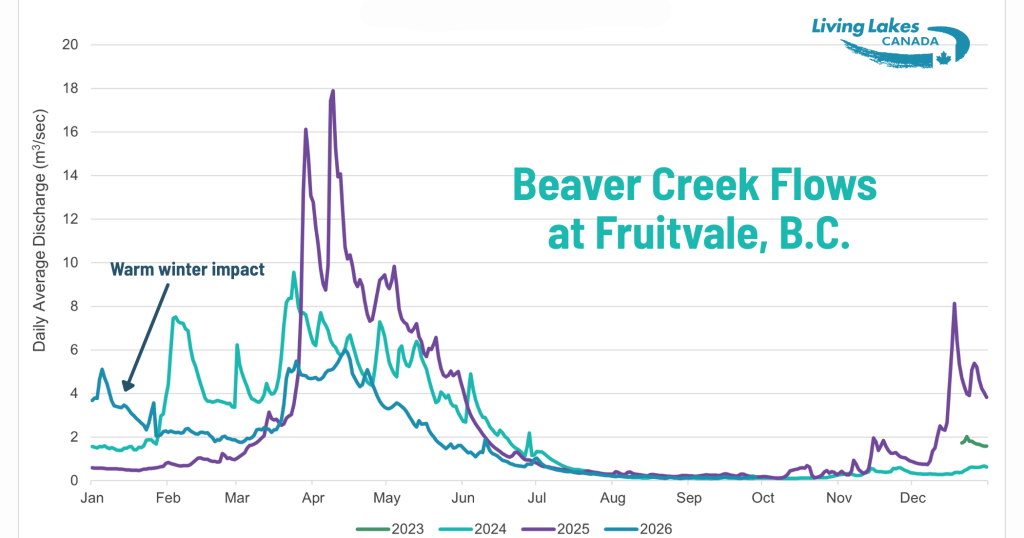
Streams that relied on lower-elevation snowmelt experienced earlier and lower freshet, and early summer drought conditions. This contrast in flow conditions from high- and low-elevation snowmelt highlights the importance of monitoring diverse streams across the Columbia Basin. The figure below shows higher winter flows and a lower spring freshet than prior years at Beaver Creek, near Fruitvale, BC.
These findings underscore how climate change increases the vulnerability of communities dependent on lower-elevation watersheds for their water supply.
“Location-specific monitoring is essential as warmer, wetter winters reduce snowpack and elevate the risk of severe water shortages,” said Arlo Bryn-Thorn, program manager for Living Lakes Canada’s Columbia Basin Water Monitoring Framework. “Climate change is happening now. We must equip communities relying on snowmelt with real-time monitoring data so they can proactively safeguard local water security.”
A late-August poll revealed that 71 per cent of British Columbians are concerned about a major water crisis in their community in the next few years, up from 57 per cent when the same question was asked in 2018. A $2-billion Watershed Security Fund is called a good idea by 76 per cent of those polled, and 83 per cent support raising water rates for B.C.’s largest industrial users to pay for fresh water protection. Currently, BC’s industrial users pay just $2.25 per million litres of water, which is by far the lowest rates for industrial water use in Canada when compared to provinces with similar licensing systems.
– 30 –
About Living Lakes Canada
Living Lakes Canada is an award-winning water science and stewardship non-governmental organization based in the B.C. Columbia Basin that facilitates collaboration in monitoring, restoration, and policy development initiatives for the long-term protection of Canada’s lakes, rivers, wetlands and watersheds. Visit https://livinglakescanada.ca/ for more information.
Contact
Hanneke Brooymans
Communications Team Lead
587-336-4396