
Where Water Connects Us: Summary of the Yukon Lakes Virtual Roundtable
At a time when northern lakes face increasing pressures, collaboration and knowledge sharing are more important than ever.
Building on the momentum of the inaugural event, the Yukon Lakes Virtual Roundtable returned for its second year on March 4th, 2026. Rooted in a recommendation from the 2023 Celebrating the Lakes event in Whitehorse, the roundtable series continues to support ongoing dialogue, highlight on-the-ground observations, and foster collaboration to inform future lake stewardship efforts.
Under the theme “Where Water Connects Us,” the event provided a space to share knowledge, explore diverse monitoring approaches, and strengthen connections across northern watersheds. This year’s program featured presentations from the Yukon River Headwaters Research Program and the Kluane First Nation SmartICE Monitoring Program on Kluane Lake, along with a transboundary government panel with representatives from the Northwest Territories, Alberta, and British Columbia. Participants engaged in thoughtful discussion, collaborative learning, and knowledge exchange to help guide future lake monitoring and stewardship initiatives.
While we can’t fully convey the richness of the conversations and knowledge shared during the roundtable, this blog summarizes key themes, highlights, and insights from both the presentations and breakout discussions.
Living Lakes Canada thanks all the speakers and participants for contributing to the first virtual roundtable, made possible with funding from the Government of Yukon. Your insights and contributions to lake monitoring and knowledge sharing are helping deepen our understanding and appreciation of these cherished waters.
Presentation #1: The Yukon River Headwaters (YRH) Research Program
Presented by: Dr. Ashley Dubnick, Senior Research Professional, Yukon University / Dr. Kyra St.Pierre, Assistant Professor, University of Ottawa / Dr. Jessica Serbu, NSERC Postdoctoral Fellow, University of Ottawa
The Yukon River Headwaters (YRH) Research Program, launched in 2023 by Kyra and Ashley following extensive community consultation, aimed to support stewards of Yukon’s Southern Lakes and study water quantity and quality across the Atlin, Tagish, and Bennett Lake watersheds. Jessica Serbu joined the team in May 2025.
The program highlighted two key initiatives:
Monitoring glacier-influenced Atlin Lake with the Taku River Tlingit First Nation (TRTFN):
Co-led by the TRTFN, this initiative used natural gradients from glaciers to headwaters, streams, and the lake to assess how glacier retreat on the southern end of Atlin Lake may influence lake and watershed health.
“We work from the top of glaciers (Llewellyn Glacier) to the bottom of Atlin Lake in a continuum that allows us to investigate glacier change throughout all these different components (emerging habitats, rivers and streams, and downstream, receiving lakes) of the watershed.” Shared Jess Serbu.
Some key findings include:
- In June and July 2025, more than four meters of ice melted at the glacier’s front.
- Hydrographs from the six main rivers flowing into Atlin Lake showed that during an atmospheric river event, non-glacial rivers responded rapidly and dramatically, while glacial rivers buffered the impacts.
In addition, lake bathymetry and water chemistry were monitored by TRTFN Land Guardians. Data collected included temperature and dissolved oxygen profiles, seasonal algae dynamics, food web interactions, and sediment cores to reconstruct past lake changes. This work is part of ongoing monitoring efforts to track how the lake and watershed respond to glacier retreat.
Assessing contaminant risks in the Bennett Lake watershed in partnership with the Carcross/Tagish First Nation.
Conducted with the Carcross/Tagish First Nation, this project developed collaborative sampling programs that combine local knowledge with classic limnological monitoring to address concerns about heavy metals and persistent organic pollutants. The work focused on sites within the Bennett Lake watershed, where legacy and active mineral extraction raise concerns about point-source contaminants in these headwater ecosystems.
Efforts targeted legacy contaminants from the gold rush, including arsenic and railroad-related pollutants. The team used a holistic approach, bridging aquatic and terrestrial ecosystems, sampling water, sediments, vegetation (including species important for wildlife and traditional use), scat, and tailings to understand contaminant pathways.
“We are taking an approach that blurs the lines between aquatic and terrestrial ecosystems, sampling everything we could find to understand how contaminants move through the watersheds,” said Kyra St. Pierre.
Similar to the Atlin Lake work, this research applied a whole-ecosystem approach, examining food webs and primary production using eDNA, and creating detailed lake profiles on Bennett Lake.
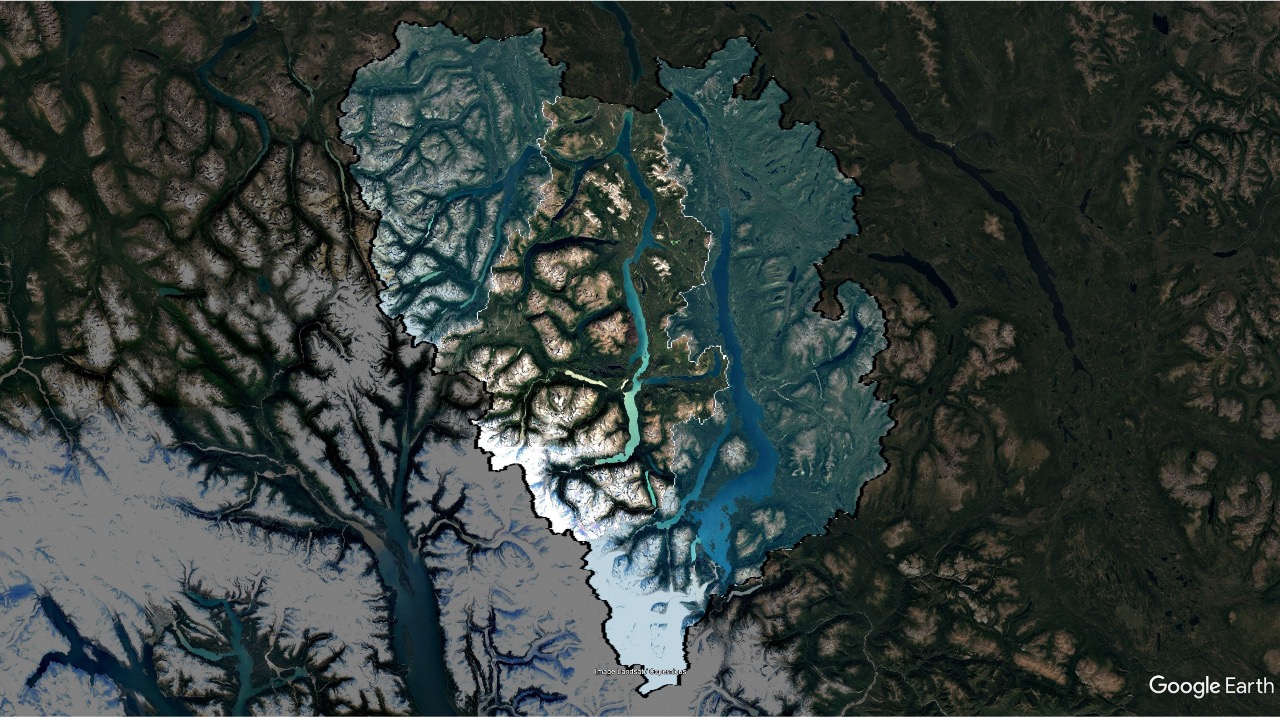
Lake Bennett Water Profile Map
Transboundary Government Panelists:
Northwest Territories Lake Water Quality Monitoring
Presented by: Robin Staples, Aquatic Quality Scientist, Department of Environment and Climate Change, Government of the Northwest Territories
The Government of the Northwest Territories’ (GNWT) lake monitoring initiatives support water stewardship, regulatory decision-making, and collaboration with Indigenous governments, communities, and partners. The GNWT maintains extensive hydrometric, snow, and water quality networks, including 111 hydrometric gauges and over 90 water quality sites, with roughly one-third focused on lakes. Monitoring is also conducted in partnership with over 20 communities, where local participants help select and monitor sites.
The transboundary river water and sediment monitoring program was highlighted, covering the Liard, Slave, Peel, and Hay rivers, with two to three decades of data and over 800 parameters measured. More recent work includes biomonitoring using benthic macroinvertebrates and fish communities. “The information being collected is essential for ongoing bilateral water management with our neighboring jurisdictions and Indigenous partners,” said Robin Staples.
The GNWT’s internal lake monitoring program assesses aquatic ecosystem health across the territory, with long-term monitoring in the Coppermine and Lockhart watersheds underway since 2000 in response to diamond mining pressures. Additional research includes work on Great Slave Lake, recovery of Yellowknife lakes from legacy arsenic contamination, harmful algal blooms in Jackfish Lake, fish mercury levels in Deh Cho lakes, lake ice development, and the impacts of permafrost thaw and warming on Arctic lake ecosystems.
Across these initiatives, the GNWT is working to better understand cumulative effects from climate change and development, while facing ongoing challenges related to extreme climate events, emerging contaminants, and the high cost of monitoring in remote northern regions.
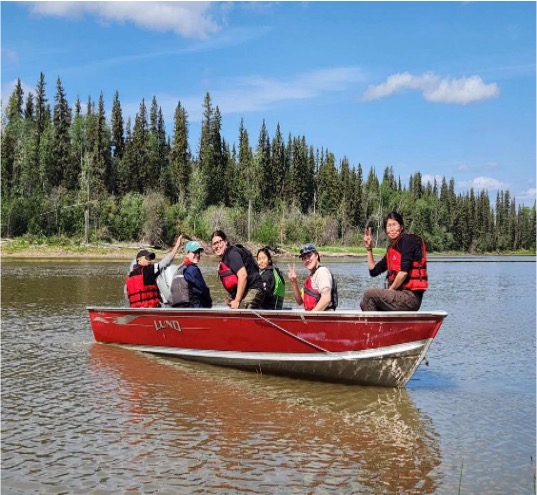
Photograph from the presentation
British Columbia
Presented by: Adrianna Johnson (R.P.Bio), Senior Environmental Impact Biologist, Ministry of Environment and Parks, Government of British Columbia
Adrianna Johnson shared an overview of British Columbia’s approach to lake monitoring, which is guided by provincial legislation, including the Environmental Management Act. Monitoring in BC is supported through permit-based requirements, standardized protocols, and centralized data systems that ensure consistency and comparability across programs.
The province uses a multi-layered framework that includes long-term monitoring of sentinel lakes, permit-driven monitoring, and the BC Lake Stewardship and Monitoring Program, which engages volunteers through citizen science.
Adrianna also highlighted how monitoring efforts are supported within the Ministry of Environment and Parks through three interconnected areas: water quality trend monitoring, environmental assessment, and water quality initiatives and partnerships. She also highlighted key programs that support this work, including the BC Lake Monitoring Network, Water Quality Objectives Attainment Monitoring, and a range of collaborative monitoring initiatives.
A strong emphasis was placed on the importance of standardized protocols, including the BC Field Sampling Manual, robust QA/QC processes, and routine checkpoints. These principles, alongside long-term datasets, centralized databases, and collaboration with diverse partners, support strong and effective monitoring systems.
As Adrianna noted, “All of these principles come together to contribute to robust monitoring networks that inform science-based decision making and adaptive management.”
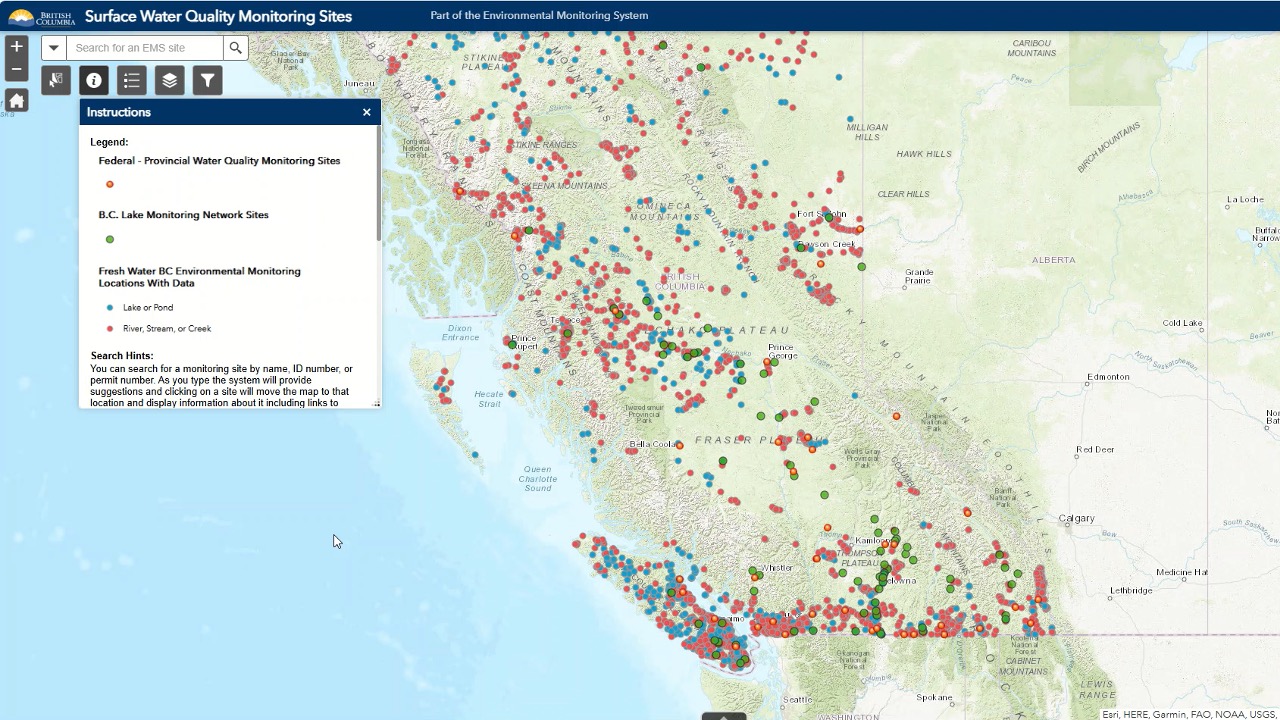
Government of British Columbia Map of Surface Water Quality Monitoring Sites
Alberta
Presented by: Craig Emmerton, Ph.D., Aquatic Scientist, Ministry of Environment and Protected Areas, Government of Alberta
Craig Emmerton discussed Alberta’s new Monitoring, Evaluation, and Reporting (MER) program for lakes and reservoirs, focusing on how the province is working to strengthen the way lake data is collected, assessed, and used.
With over 13,000 lakes, many of them remote and difficult to access, he noted that monitoring had historically focused on southern regions and was often reactive, driven by industrial impacts or community concerns. Increasing pressures such as drought, algal blooms, and invasive species highlighted the need for a more proactive and coordinated approach.
He described how the MER framework was developed to shift toward a more precautionary model, aiming to better understand current lake conditions, track changes over time, and identify their causes. Core efforts included long-term monitoring, the use of sentinel lakes for ecosystem-level insights, and targeted programs such as aquatic invasive species monitoring. Partnerships were emphasized as essential, particularly with organizations like the Alberta Lake Management Society, which support community engagement and data collection.
Emmerton also highlighted the role of technology and data accessibility, including the use of satellite monitoring to track harmful algal blooms and a provincial water quality data portal to improve data sharing. He emphasized the importance of ensuring that monitoring leads to meaningful outcomes, noting that data is often collected but not always analyzed or applied.
“What’s new with the MER plans is the evaluation and reporting portion… it puts government and scientists on the hook to make sure we evaluate and report on the data we are collecting,” shared Craig Emmerton.
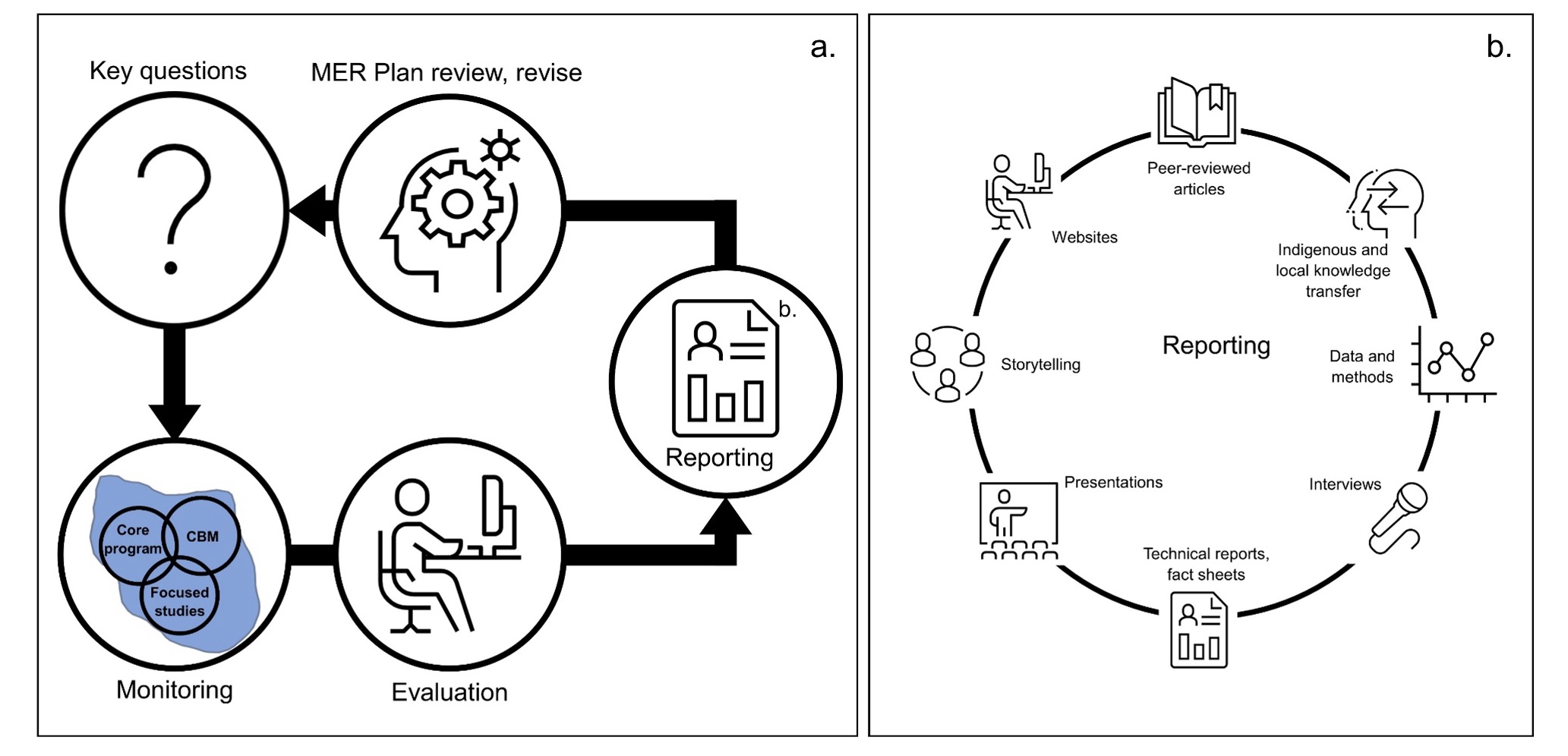
Summary of the MER framework process.
Presentation #2
Presented by: Jamie Roddick, Environment and YESAA officer, Kluane First Nation
Kluane First Nation (KFN) recently partnered with SmartICE to initiate an ice monitoring program on Kluane Lake. Smart Ice is a social enterprise that empowers Indigenous communities to make informed decisions regarding ice travel by combining Indigenous knowledge, sensor technology (such as smart buoys and ground-penetrating radar), and satellite imagery.
Jamie shared that From November to April, the Kluane lake is a winter highway to traditional trapping lines, fishing and hunting areas, and firewood sources. However, due to glacial changes in 2017, the lake experienced significant water level drops, thinning ice, exposing previously used boat docks and changing groundwater upwellings, which increased ice safety hazards. There are many factors impacting ice thickness on Kluane Lake, including wind, climate change, and snow. This work helps us understand what’s affecting ice thickness and safety.
The Kluane Lake ice monitoring program is operated by a SmartICE trained KFN citizen who deploys four stationary snow and ice thickness sensors at strategic travel locations in the ice and operates a mobile ice profiler towed along community trails.
Jamie highlighted how this SmartICE program has strong community impact, and demonstrated that the success of the KFN ice monitoring program has encouraged similar initiatives by the Taku River Tlingit First Nation land guardians on Atlin and adjoining lakes and the Dane Nan Yḗ Dāh – Kaska land guardians on Liard and Dease rivers.
The program is not just about technology; it is about building community resilience, training local youth and land guardians, and enabling safer access to traditional areas like trap lines and cabins.
“The board of directors of Smart Ice is (I think) comprised of 100% First Nations members, it’s more than a technology, its about connecting to the people, and the people connecting to the technology, it’s about giving power back to the first nations to make decisions for themselves.” said Jamie Roddick.
This ice and snow data is uploaded online and publicly accessible for community members to easily access, and increase informed decision making.
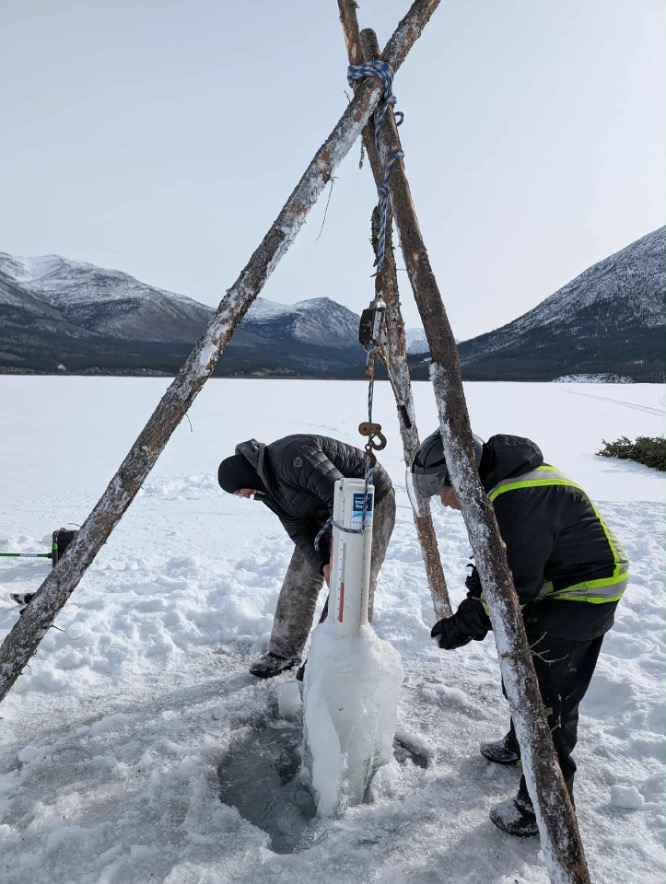
SmartICE program participants testing ice thickness.
Breakout Groups and Discussions
Conversations throughout the breakout sessions highlighted a shared interest in strengthening collaboration and building a more connected approach to lake monitoring across the Yukon. Participants reflected on the strong foundation already in place, and the opportunity to link existing programs, share knowledge, and better coordinate efforts across First Nations, governments, researchers, and communities. Combining on-the-ground monitoring with satellite data was also seen as a valuable way to expand understanding, particularly in remote areas.
Data sharing emerged as a key theme, along with the importance of ensuring information is not only collected, but meaningfully used to inform decisions and support stewardship. Participants emphasized the need for clear processes that respect Indigenous data sovereignty, while making data accessible and useful for those who need it.
There was a strong sense that long-term success will depend on continued collaboration, community involvement, and sustained support. Ideas such as starting with pilot lakes, creating spaces for ongoing dialogue, and building on existing partnerships point to a path forward grounded in shared learning and collective action.
Want to learn more about the Yukon Lakes Monitoring Initiative? Visit the program page.
Thank you to the Government of Yukon for generously funding this event.